

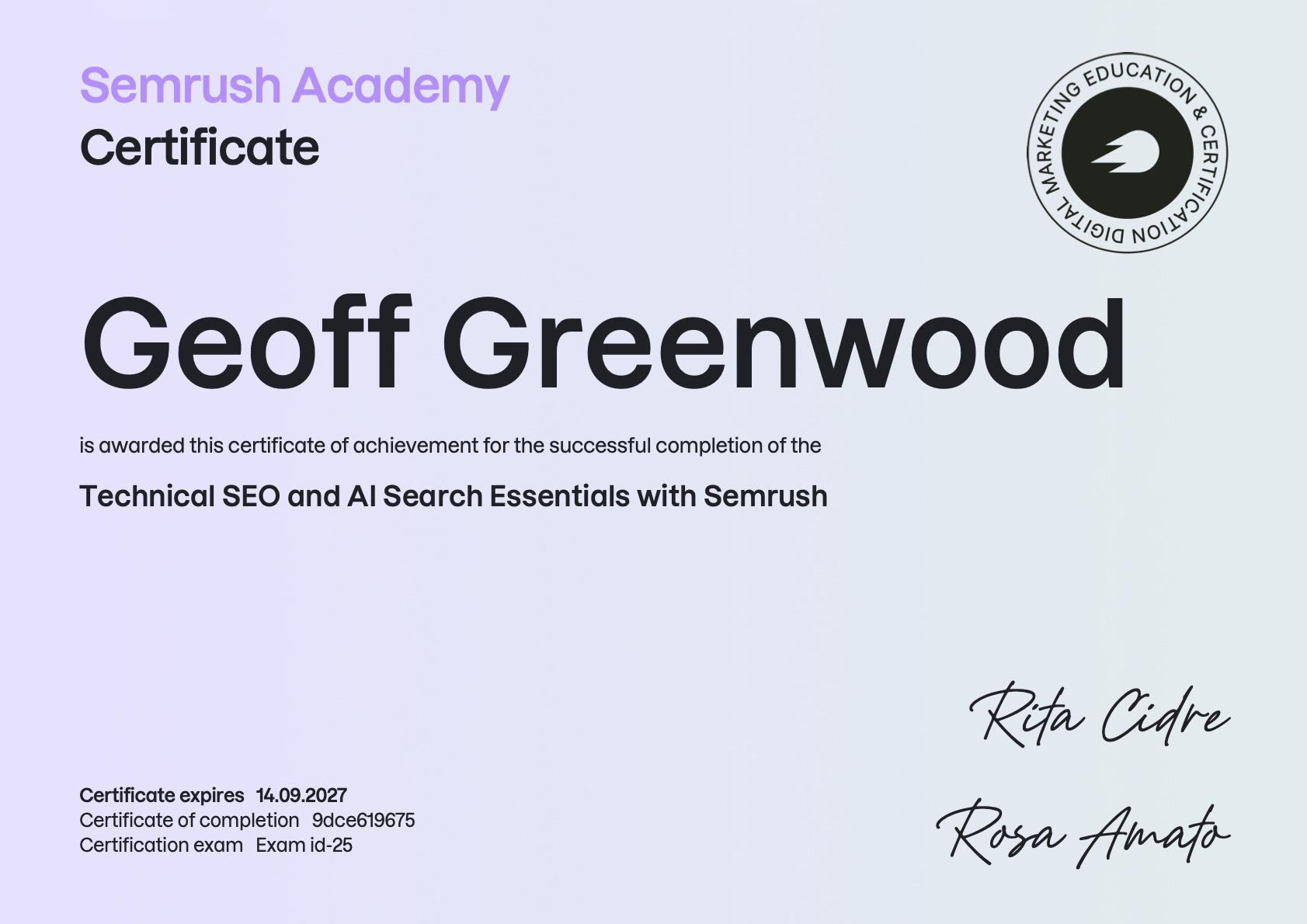
I recently completed Semrush Academy’s Technical SEO and AI Search Essentials certification.
I didn’t take the course because I was starting from scratch with SEO. A lot of the material covered things I’ve been working with for years, including technical SEO, crawlability, indexing, site structure and the fundamentals of building websites that search engines can understand.
For me, that was actually part of the reason for doing it.
SEO changes constantly. Tools change, terminology changes and the way people find information online is changing particularly quickly with the growth of AI search. I think it’s useful to regularly go back to established sources and see how they are currently teaching and defining good SEO practice.
It’s also useful to occasionally challenge your own assumptions.
When you work with websites every day, it’s easy to develop your own methods based on experience. That’s valuable, but I don’t want my knowledge to become a collection of things that worked five years ago and I’ve continued doing ever since.
SEO isn’t something I only work on when a client asks for it.
I run and manage several of my own websites, and organic search is an important part of how those businesses acquire customers.
That has given me a slightly different relationship with SEO over the years. I’m not looking at rankings purely as a report to send to somebody else. I’m looking at what happens after someone searches.
Do they find the right page? Does the page answer what they were looking for? Do they trust the business? Do they make an enquiry or booking?
I’ve built websites targeting different services and locations, worked on local search, created long-form informational content, improved internal linking and site structure, and spent a lot of time thinking about search intent.
Because they’re my own businesses, I also get to see the longer-term effects of those decisions.
Some SEO work produces obvious results. Some takes months to become useful. Sometimes Google starts ranking a page for searches I hadn’t originally considered. Sometimes an article written to answer a relatively narrow question becomes an important entry point into the website.
That practical feedback loop has probably taught me more about SEO than anything else.
Alongside actually doing the work, I regularly read SEO articles, listen to podcasts and take shorter courses and certifications.
There are two reasons I find courses like this useful.
The first is keeping my knowledge current. The second is checking that the things I’ve learned through experience still line up with current best practice.
This particular course also gave me an excuse to spend some more time inside Semrush and its SEO tools.
SEO platforms have become increasingly sophisticated. Site auditing alone now brings together information about crawling, indexing, structured data, internal links, Core Web Vitals, HTTPS and many other technical elements of a website.
Knowing SEO principles is important, but knowing how to efficiently find and diagnose problems is useful too.
The biggest takeaway from the course was the distinction between traditional SEO and GEO, or Generative Engine Optimization.
GEO is concerned with improving the chances that content and brands can be understood, referenced or surfaced by AI-powered search and answer systems.
There’s obviously a huge amount of discussion around this at the moment, and I was interested to see how Semrush approached it.
What stood out to me was how much the foundations of good SEO still matter.
A website still needs to be crawlable. Pages need clear structure. Search engines and other systems need to understand what the website, business and individual pages are about. Content needs to be useful, specific and trustworthy.
Those principles haven’t suddenly disappeared because people are using AI.
There are additional technical considerations for AI search, and there are differences in how content can be discovered, interpreted and cited by generative systems. That makes GEO an interesting new layer to consider when building and optimising websites.
But my main takeaway wasn’t that GEO replaces SEO.
It was that strong SEO provides much of the foundation that GEO builds upon.
I’ve always been interested in the point where web design, SEO and the actual commercial purpose of a website meet.
A website can look great and still be difficult to find. It can rank well and still do a poor job of convincing somebody to contact the business.
The best results come when these things are considered together.
That’s particularly important for the kinds of websites I increasingly work on at Exposure Creative, including professional service businesses and boutique hospitality, where trust plays a major part in someone’s decision.
Page structure, photography, written content, technical performance, search visibility and user experience all contribute to that.
SEO is therefore something I prefer to think about during the design and development of a website, not as something to bolt on after the website has been built.
Completing a certification doesn’t suddenly make somebody an SEO expert, and that isn’t how I see courses like this.
For me, they’re part of a much bigger process.
I learn from the websites I run, from client projects, from experiments that work, from things that don’t work, from industry publications, podcasts, SEO tools and courses like this one.
Search is changing quickly at the moment, particularly as Google and other platforms integrate more AI-generated answers into the search experience.
That makes it even more important to keep learning while holding onto the fundamentals that continue to work.
The Semrush Technical SEO and AI Search Essentials course was a useful opportunity to do exactly that, and the GEO section in particular gave me a few more things I’ll be keeping in mind as I build and optimise websites in the future.
The useful part of keeping up with changes in search is being able to apply them to real websites.
For me, that means taking what I learn and testing it against the websites I manage, then bringing that experience into my client work at Exposure Creative.
SEO and search visibility are considered from the beginning of every website I build, alongside design, usability and the needs of the business itself.
I’m Geoff Greenwood, a web designer based in Cambodia, creating thoughtfully designed websites for professional service businesses and boutique hospitality.
My work combines web design, SEO and practical experience running my own websites, where organic search plays an important role in generating enquiries and bookings. That experience influences how I approach site structure, content, technical performance and user experience.
I also have an extensive background in commercial photography, which gives me a strong understanding of how photography and visual content can be planned specifically for websites.
I continue to develop my skills through hands-on work, industry research and professional training, applying what I learn across my own websites and client projects.